Kunsthal Aarhus Skulpturpark
–
FOS, Henriette Heise, Jillian Mayer, Jimmie Durham, Ronan & Erwan Bouroullec, Sophia Ionnaou Gjerding, Uffe Isolotto, Willy Ørskov
–
Marking the 2017 centenary of Kunsthal Aarhus, the park surrounding Kunsthal Aarhus has been transformed into a sculpture park with works by Danish and international artists. Works are continuously added to Kunsthal Aarhus Skulpturpark, which in turn makes it possible for passers-by to experience and perceive art at all hours of the day.
Current
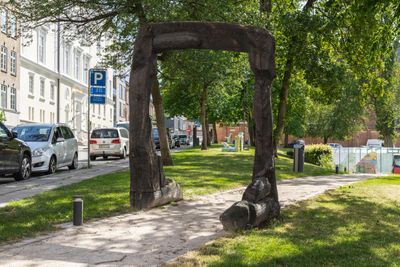
By the pathway on the corner of J.M. Mørks Gade and Christiansgade you will find FOS’s wooden portal Hypernormalization, 2017.
By the pathway on the corner of J.M. Mørks Gade and Christiansgade you will find FOS’s wooden portal Hypernormalization, 2017. Made of scorched larch, the work was originally created for an exhibition at the French Embassy in Copenhagen, marking the transition from Danish to French territory. At Kunsthal Aarhus the work lives on as a portal. It no longer separates national territories, but marks out the physical and mental transition from the mundane pavement to the world of contemporary art.
FOS is internationally acclaimed for his uncompromising works that explore the relationship between art and design. Blending functionality with popular culture, he explores how physical settings and social relationships affect each other. The works often form a platform for social activities and experiences, bringing people together in the social space we all share. Art, design and architecture merge into a hybrid format that the artist himself calls ‘social design’.
FOS is an alias for Thomas Poulsen (b. 1971, DK), who works with sculpture, design, performance and installation art. He is a graduate from the Royal Danish Academy of Fine Arts, where he studied from 1993 to 2000.
Material: Larch
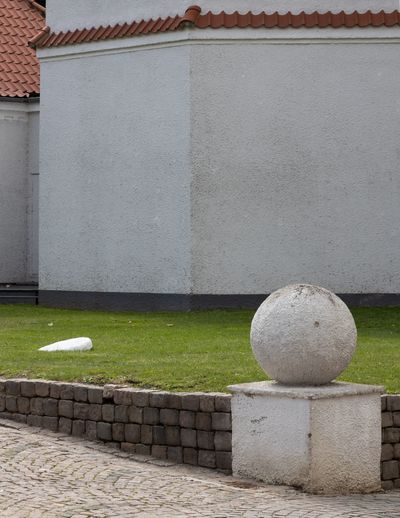
Henriette Heise’s flat planet has landed in Kunsthal Aarhus’ Park. Settled on the grass between the main building and the two globe finials that mark the entrance to the park, The Flanet lurks, grounded and brought low.
Henriette Heise’s flat planet has landed in Kunsthal Aarhus’ Park. Settled on the grass between the main building and the two globe finials that mark the entrance to the park, The Flanet lurks, grounded and brought low. It is a depressed sculpture. The Flanet can scarcely summon the energy to sufficiently act like a sculpture. It prefers to disappear, camouflaged behind the same coarse surface of trowel-thrown roughcast and paint as both the building and the globes. It prefers to drift about the park unseen, hoping to pass for just another globe, just another part of the Kunsthal’s familiar facade. With the arrival of The Flanet, Kunsthal Aarhus has one more celestial body orbiting its system. However seemingly inconspicuous its presence, The Flanet’s appearance fundamentally shifts the cosmology. Things will never be the same again. The Flanet is related to The Depressed Planet. Both characters continue to make increasingly exhausted appearances in the work of Heise.
Slumpies, 2018, is a series of colourful sculptures created by US artist Jillian Mayer, who intends them to prop up the human body.
Slumpies, 2018, is a series of colourful sculptures created by US artist Jillian Mayer, who intends them to prop up the human body. ‘When I was in public, I noticed people with their chins resting against their necks and their eye gaze low towards their phone screens, which was positioned around their sternum level,’ explains Jillian Mayer. ‘These people were all in public doing very social things, yet they needed or preferred to tend to their digital worlds. I wondered if there was a way to create an object allowing participants to use their phone, while simultaneously engaging and disengaging from the environment they were physically present in’.
Each of the fourteen sculptures in the Kunsthal Aarhus Sculpture Park has its own unique shape and size, creating ideal conditions for each person to arrange themselves exactly as they prefer – standing, sitting or lying down.
‘There are no explicit directions for how to approach each piece, but visitors are permitted to interact with the works freely. A funny little dance occurs when a person is trying to figure how best to control their body into a structure that allows interaction’, says the artist.
Slumpies is likely to have a build-in expiry date. As technology evolves, the ergonomic sculptures will lose their relevance as furniture. ‘In several years we are not going to be holding phones the same way we do currently and Slumpies will just be sculptures’, points out Mayer.
The fourteen sculptures were installed in the sculpture park in November 2018 by Jillian Mayer herself. Visitors and passers-by can interact with the sculptures independently of the opening hours of Kunsthal Aarhus.
Jillian Mayer (b. 1986, USA) resides in Miami and graduated from Florida International University in 2007.
Slumpies was exhibited at Roskilde Festival in 2018. They were also exhibited at Ofelia Plads in Copenhagen that same year.
Material: Foam plastic, jesmonite, fiberglass plates, epoxy resin,
acrylic paint, plywood
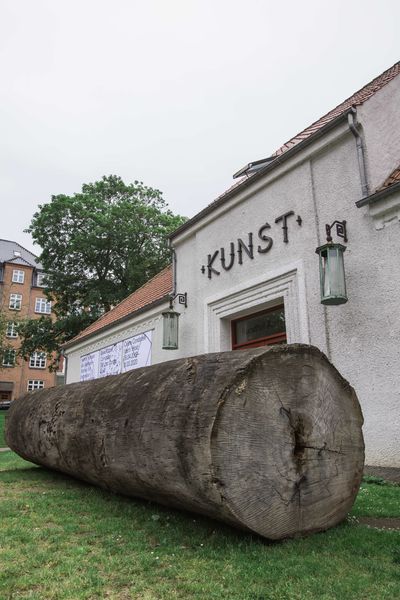
Durham's monumental sculpture Pagliaccio non son (2011) (I am no Clown) in Kunsthal Aarhus’s Sculpture Park is a vast mahogany log from Congo originally imported to Germany
Durham's monumental sculpture Pagliaccio non son (2011) (I am no Clown) in Kunsthal Aarhus’s Sculpture Park is a vast mahogany log from Congo originally imported to Germany to end up as veneer in exclusive yachts – but thanks to the artist’s intervention it has been given new life as a sculpture. By exhibiting it in all its simplicity and impressive heft, Durham shows us the majestic beauty of this tree, thereby also pointing out how thoughtlessly we often treat our natural resources. With the title of the work, Pagliaccio non son, Durham gives the tree its own voice and identity. The tree resists its prescribed fate and insists that it is more than just a clown. In addition, Pagliaccio non son demonstrates Durham’s black, critical humour and offers insight into the political and cultural discourses that shape our society and worldview.
Jimmie Durham (b. 1940) is an American artist, performer, poet and activist who works with natural and artificial materials in his artistic practice. He is particularly concerned with the qualities embedded in objects that have been used as tools over time: wood, stone, bones, iron and glass. Through his studies of these objects, Durham unveils the Western world’s prejudices and assumptions and presents alternative, non-Western ways of viewing the world.
Durham received the Venice Biennale Golden Lion in 2019 for his lifelong contribution to art. He has exhibitied at The Whitney Biennial (New York), documenta IX (Kassel), The Institute of Contemporary Arts (London), Muhka (Antwerp) and the Palais des Beaux-Arts (Brussels).
Jimmie Durham lives and works in Berlin, Germany and Naples, Italy.
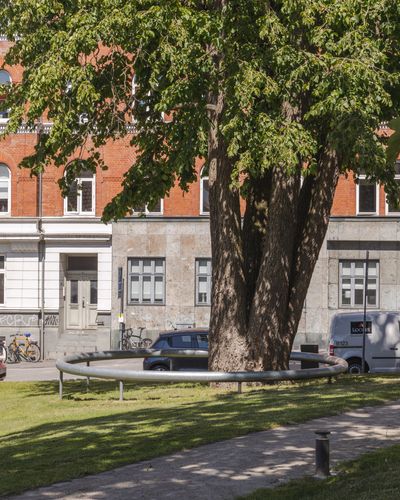
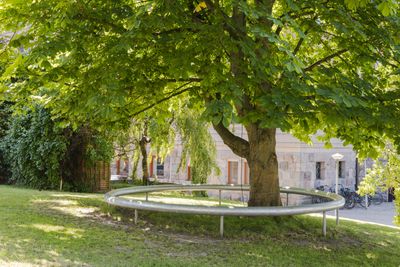
The brothers Ronan & Erwan Bouroullec have designed a series of outdoor seating installations collectively titled OUI (2017).
The brothers Ronan & Erwan Bouroullec have designed a series of outdoor seating installations collectively titled OUI (2017). Each of the four installations consists of a circular shape made of galvanised steel. Three of these circles surround large trees in the park, while the fourth makes up a fire pit by the main entrance. OUI acts as seating, backrest – and as a balance beam. Or you can lean up against the tree in the middle of each circle to regard them from the inside out. With OUI, the trees take on a definite function as places to meet and rest.
With the four installations, the Bouroullec brothers explore how art, design and function can merge in public spaces. Instead of using natural materials, they let the steel remind us that we occupy a modern urban setting.
The inspiration for the installations at Kunsthal Aarhus sprang from the Bouroullecs’ exhibition Rêveries Urbaines in Rennes, France, in 2016, where the artists presented a number of different designs for urban use.
Ronan & Erwan Bouroullec (b. 1971/1976, FR) are graduates from, respectively, the École nationale supérieure des arts décoratifs and the École nationale supérieure d'arts de Paris-Cergy in France. They are internationally acclaimed for their collaboration with Danish design companies HAY and Kvadrat.
OUI is produced in collaboration with Kvadrat and supported by the Nordea Foundation, the City of Aarhus, Kvadrat and European Capital of Culture Aarhus 2017.
Material: Galvanised steel
Along Christiansgade you will find Uffe Isolotto’s Universal Serial Bus, 2018.
Along Christiansgade you will find Uffe Isolotto’s Universal Serial Bus, 2018. The work echoes the design of the parking metres already found in the street and mimicks the architecture of the surrounding urban landscape – which includes the Masonic lodge and a building belonging to a Danish bank; Danske Bank.
The title points to the type of small connecting device commonly abbreviated as USB; plugs that allow us to transfer data or charge batteries. Thus, the work directly addresses part of the modern human condition: our connection to lifeless technologies has become fundamental to our self-understanding. When we connect our devices to a larger circuit via such electronic umbilical cords, we expose them and ourseves, thereby becoming vulnerable.
The sculpture is made out of metal, nuts and bolts, padlocks fitted with alarms and USB ports fitted with LED lights. Inside, the machine contains air-dried animal meat: skin and guts, ears and tails, tendon, trachea and a penis.
The organic contents inside the work will eventually rot and spoil. The iron grid will turn rusty. And the USB ports appearing in this work will become obsolete as new technology is developed. In this way, Isolotto has created a display case that does not preserve its contents; rather, it demonstrates the fleeting nature of time itself as a fragile material.
Uffe Isolotto (b. 1976, DK) is a graduate from the Royal Danish Academy of Fine Arts. In his practice, he takes his starting point in the digital aspects of modern life in an attempt to redirect our habitual world views. He experiments with performance, interventions, immersive installations, digital art and video animations as well as with more traditional modes of expression such as photography and sculpture.
Material: Steel, metal nuts, padlocks fitted with alarms, LED USB ports. Air-dried animal meat: skins, liver, lungs, oesophagus, tails, ears, cow’s bellies, tendons, trachea and penis
Sophia Ioannou Gjerding is behind the flag for Kunsthal Aarhus Sculpture Park, which is entitled Rebreather: The wind as a drunk
Sophia Ioannou Gjerding is behind the flag for Kunsthal Aarhus Sculpture Park, which is entitled Rebreather: The wind as a drunk , 2020. The flag is inspired by Disney’s first colour cartoon: Flowers and Trees from 1932. The film depicts an idyllic flora in which nature possess human traits – the flowers brush their teeth, dances and performs morning gymnastics. The flag Rebreather: The wind as a drunk also depicts nature as something which possesses human traits – a drunkard who is blowing. When the wind is extra strong, the drunkard is out of control.
Rebreather: The wind as a drunk is constructed as a windsock. A windsock is a cylinder of fabric used to show the direction and strength of the wind. Windsocks are typically installed in airports and at locations with a risk of gas-leeks. A windsock is divided into segments which are filled one by one with air depending on how windy it is. The segments on Rebreather: The wind as a drunk are used as a sequenced frame that shows a determined movement: The wind takes the shape of a face blowing wind.
Sort Granit fra Congo was created by the Aarhus-based artist Willy Ørskov in 1977. That same year, the work was placed
Sort Granit fra Congo was created by the Aarhus-based artist Willy Ørskov in 1977. That same year, the work was placed on the lawn in front of what was then the main entrance of Kunsthal Aarhus in J.M. Mørks Gade.
The sculpture is a classic example of outdoor art done in granite, drawing on art-historical traditions for the processing of materials.
But the sculpture is also part of a revolt against the romantic notion that art should be a shortcut to the human mind, charged with special meaning and significance.
‘The content of sculpture is sculpture’, Ørskov is quoted as saying. His oeuvre is characterised by an absence of recognisable subjects or narratives.
As part of the postmodernist movement of the 1970s, Ørskov opposed any interpretation of his sculptures. Instead, Ørskov applied the concept of reading.
Willy Ørskov (1920–1990, DK) was a graduate from Valands Konstskola in Gothenburg, Sweden. From 1978 to 1984 he was a professor of sculpture at the Royal Danish Academy of Fine Arts in Copenhagen.
Sort Granit fra Congo is a permanent installation in the Sculpture Park of Kunsthal Aarhus.
Material: Granite
Upcoming
Spaceframe Complex at Kunsthal Aarhus Skulpturpark will open in the Spring of 2020. Spaceframe Complex is a low-cost, movable lightweight construction
Spaceframe Complex at Kunsthal Aarhus Skulpturpark will open in the Spring of 2020. Spaceframe Complex is a low-cost, movable lightweight construction that can easily be transformed. It is dimensioned as a living unit for 2-4 persons and demands practically no maintenance. The construction can be erected by anybody in a short period of time.
We will invite you to the opening once the work is ready. Hereafter, it will be possible to book Spaceframe Complex for events, meetings, talks, workshops and so on without costs. It will not be possible to use Spaceframe Complex for commercial activities.
One of the artists behind Spaceframe Complex is Rikke Luther (b. 1970), who also is the artist behind the exhibition Corruption – We Lost Control Again at Kunsthal Aarhus in 2019. Luther’s main field of interest and artistic focal point concerns the study of the state of the world: How humanity takes natural resources for granted, and in some cases commercialising them beyond the capacity of nature’s vulnerable systems, which may ultimately lead to ecological collapse. Extreme weather conditions, rising water levels, pollution, and overproduction, not least our increasing sense of powerlessness in the fact of these issues, inform the public debate. Therefore, it is crucial to consider the themes from different scientific angles and, of course, from an artistic angle like Rikke Luther’s.
Previous
In the flagpole at Kunsthal Aarhus flew a banner created by artist Henrik Plenge Jakobsen in 2019: Stripes and Stripes
In the flagpole at Kunsthal Aarhus flew a banner created by artist Henrik Plenge Jakobsen in 2019: Stripes and Stripes . The piece was sewn out of material taken from two Stars & Stripes flags, the official flag of the United States of America. Plenge Jakobsen raised the flag himself at a ceremony held in February 2019 in relation with the finissage of the exhibition Post Institutional Stress Disorder (PISD).
Plenge Jakobsen’s artistic practice revolves around a critique of the fundamental political, economic and social structures underpinning modern society. He often designs works for public spaces, letting them intervene in and interfere with their settings.
Plenge Jakobsen works with multiple media. In his installations, he often juxtaposes sculptural elements with performance, photography and murals.
Henrik Plenge Jakobsen (b. 1967, DK) is a graduate from the Royal Danish Academy of Fine Arts in Copenhagen.
Material: Fabric from two Stars & Stripes flags
Neon works by Nat Bloch Gregersen & Matilde Mørk, Theta Wave (2017), Solidarity is not Old Fashion (2017) and Follow the Horse II (2017). The three works revolved around different modes of lingering and devoting oneself to a collaboration: Follow the Horse II is for example based on a horse therapy exercise that the artists had translated into a collaborate drawing exercise. The works were initially produced for Kunsthal Aarhus’ exhibition at Roskilde Festival 2017.
Supported by